For US business owners, the S Corp vs LLC question usually starts in a very domestic place.
You build a business. The profit gets real. Your CPA tells you that once you’re making enough, an S Corp election may help reduce self-employment tax. To be clear, this is completely valid advice for many US-based business owners.
But then you move abroad, and the question evolves, often becoming intimidatingly more nuanced. It is no longer just a matter of, “Which structure saves the most US tax?”
We ask: Which structure still makes sense given another country’s income tax, social tax, business registration rules, and reporting requirements?
From here, we evaluate your specific set of facts, looking at:
- where you are moving
- whether the US has a totalization agreement with that country
- how you pay yourself, and
- how your local country treats the entity.
This article is designed to help you understand the framework before you make the move, close the entity, elect S Corp status, or assume the structure that worked in the US will keep working abroad.
Save for later: Learn about our Moving Abroad Business Advisors Package.
How the S Corp vs LLC Decision Works in the US
In the US, the S Corp vs LLC discussion often centers on self-employment tax.
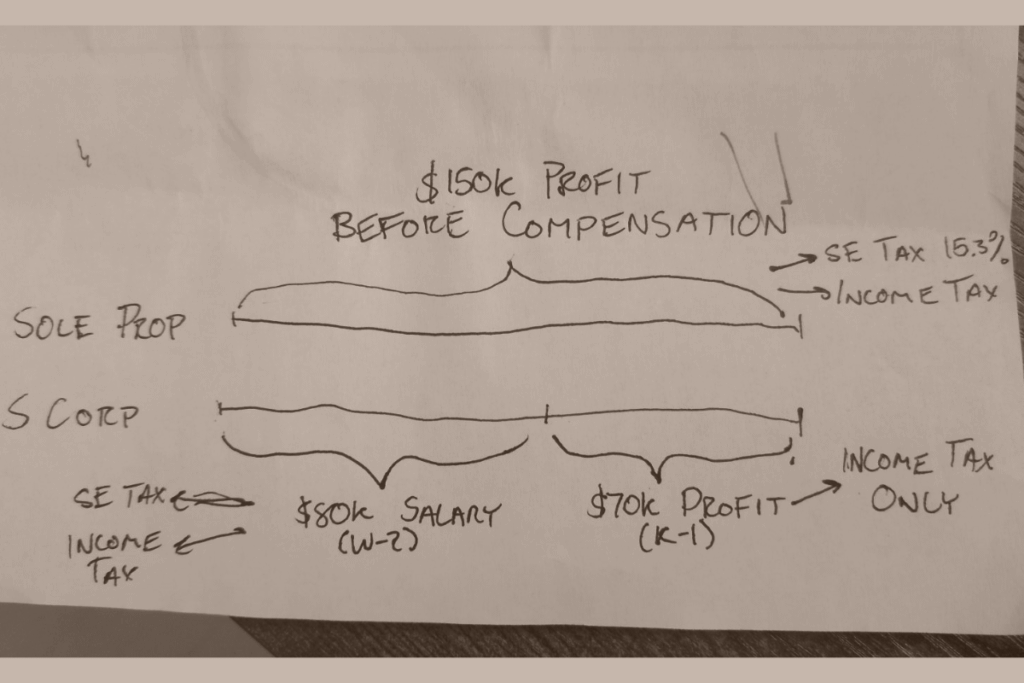
A plain LLC, single-member LLC, sole proprietorship, or independent contractor structure is generally simple. The business income flows through to the owner. The owner reports the profit on their individual tax return. The downside is that the profit is subject to both income tax and self-employment tax.
Self-employment tax is the Social Security and Medicare layer. For self-employed individuals, the combined rate is 15.3%, covering Social Security and Medicare.
At around 150,000 in business profit is generally where the S Corp conversation comes up
Now, an LLC is a legal entity formed under state law. An S Corp is a federal tax election that changes how an eligible Corporation or LLC is taxed. A single-member LLC is usually disregarded for US federal tax purposes unless it elects otherwise. An S Corp files its own tax return and requires owner compensation to be run through payroll.
In the US, an S Corp can reduce self-employment tax when business profits are high enough. By “high enough” we generally mean they must justify payroll, tax filing, and reasonable compensation requirements. The business profit still flows to the owner, but the structure allows the owner to split income into two broad categories. These are:
- salary (reported on Form W-2) and
- pass-through profit (reported on Schedule K-1).
The salary is paid through payroll and is subject to Social Security and Medicare taxes.
The remaining S Corp profit is still subject to income tax, but it is generally not subject to self-employment tax, and therein lie the tax savings. Under the right circumstances, making an S Corp election can minimize the amount of business profit exposed to US Social Security and Medicare.
For a business owner making a substantial profit, that can be meaningful. If the owner pays a reasonable salary and leaves the remaining profit as S Corp profit, the tax savings can more than cover the cost of payroll and the additional S Corp tax return.
The Catch: Reasonable Compensation
Electing S Corp status is not a “pay yourself nothing and call everything profit” strategy.
The IRS requires an S Corp shareholder-employee to receive reasonable compensation for the services they provide to the Corporation.
That means the owner needs to run payroll and pay themselves a defensible salary before taking non-wage distributions.
Reasonable compensation is one of those tax concepts that sounds straightforward until you try to apply it. A reasonable salary depends on the industry, the owner’s role, experience, time spent in the business, revenue, profitability, and what the company would pay someone else to do similar work. The business owner essentially needs to apply the same process they would use to negotiate a beneficial salary in a traditional employment context to their own business.
At Rook, we offer support with a reasonable compensation analysis
The goal is not to find the lowest possible number. The goal is to find a number that is defensible.
That matters in the US. It matters even more when moving abroad, because the salary number can implicate more than payroll tax. It can affect foreign earned income planning, local taxation, and how much of the business profit is actually eligible for certain US expat tax benefits.
What Changes When You Move Abroad?
Once you move abroad, the S Corp vs LLC decision stops being a purely US entity question.
Now you have a set of questions to ask, including but not limited to:
- Which country will tax the business income?
- Will you pay local social taxes?
- Does the US have a totalization agreement with that country?
- Will US Social Security and Medicare still apply?
- Can foreign tax credits reduce US income tax?
- Is the business structure respected locally?
- Does the local country treat the S Corp as a separate entity, a controlled foreign corporation, or something else entirely?
Cross-border scrutiny can materially affect an otherwise sound US tax plan
The main reason an S Corp helps in the US is that it reduces US self-employment tax. But if you move to a country where a totalization agreement eliminates US Social Security and Medicare exposure, the S Corp may be solving a problem that doesn’t exist.
The structure that saved money in the US may become the structure that adds payroll, filing costs, and foreign reporting abroad.
What Is a Totalization Agreement?
A totalization agreement is a Social Security agreement between the US and another country.
These agreements are designed to prevent workers from paying into two Social Security systems on the same income and to help people preserve benefit eligibility when their working years are split between countries. The Social Security Administration describes these agreements as having two main purposes: eliminating dual Social Security taxation and helping fill gaps in benefit protection for people who have divided their careers between the US and another country.
For business owners, the first part is the one we typically focus on first.
If the US has a totalization agreement with the country where you live and work (such as Spain, France, Portugal, or Italy), the agreement may determine which social security system covers your income. If you are covered by the foreign system, you may be exempt from US Social Security and Medicare taxes.
Claiming exemption from paying into US Social Security looks different than claiming a foreign tax credit
A foreign tax credit is generally a dollar-for-dollar credit against income tax. You pay tax to France, Spain, Italy, or another country, and then you may use that foreign income tax to reduce US income tax on the same income.
A totalization agreement is all-or-nothing. It asks which social security system applies. If the foreign system applies, the US social tax may be removed from the equation for that income.
That distinction is crucial when deciding whether to maintain your S Corp election or change tactics when you move abroad: If the S Corp exists primarily to reduce US social tax, and a totalization agreement already eliminates that US social tax, the S Corp may have lost its main purpose.
The Certificate of Coverage
Totalization agreement planning is not just theoretical. You need proof.
In practice, a taxpayer may need a certificate of coverage from the local social security authority showing that they are covered by that country’s system (e.g, an attestation des droits via Ameli in France). The IRS explains that self-employed individuals who claim exemption from US Social Security and Medicare taxes because of a totalization agreement must secure a Certificate of Coverage from the social security agency of their country of residence.
That certificate usually has an effective date range, though it’s not necessarily attached to the tax return every year. Often, the tax filing includes an explanatory footnote. But if the IRS asks for proof, you need to be able to provide it.
That is why timing matters. If your local country takes months to issue coverage documentation, waiting until an IRS notice arrives can be stressful. The notice response window may be shorter than the local bureaucracy’s processing time.
A practical planning point: once you know you will rely on a totalization agreement, understand which local authority issues the certificate, how long it usually takes, and whether the certificate covers one year or a longer period.
This is not glamorous planning. It is the kind of admin that prevents expensive confusion later.
Totalization Agreement? The LLC Often Looks Cleaner
If you move to a country that has a totalization agreement with the US, and you are properly covered by the local social security system, a single-member LLC may often be cleaner than an S Corp.
With a plain LLC, the business income flows through to you as the individual owner. If you are paying local social taxes and the totalization agreement applies, you may be exempt from US self-employment tax on that income. You still need to deal with US income tax, local income tax, and foreign tax credits, but the US social tax problem is covered.
The LLC still needs to be paired with local registration, invoicing, and tax rules. But it is often administratively simpler than an S Corp. This is because it does not require payroll, an S Corp return, reasonable compensation analysis, or the same corporate reporting footprint abroad.
| Moving to… | General planning direction |
|---|---|
| Country with a totalization agreement | LLC may be cleaner because U.S. social tax may already be removed |
| Country without a totalization agreement | S corp may still be useful because U.S. social tax may still apply |
| Country with special local regime | Model both U.S. and local-country treatment before choosing |
No Totalization Agreement? When to Keep an S Corp
The cross-border tax strategy changes if you move to a country without a totalization agreement.
In that case, you may still be exposed to US self-employment tax while also paying local social taxes or local equivalents. That is where the S Corp can still have value, because it may reduce US Social Security and Medicare exposure on profit above reasonable compensation.
A Helpful Framing
If totalization removes US social tax, the S Corp may be unnecessary. However, if totalization does not remove US social tax, the S Corp may still deserve a serious look.
The FEIE Problem: S Corp Profit Does Not Qualify as “Earned”
There is another cross-border complication with S corps: the Foreign Earned Income Exclusion.
For a US business owner living abroad, the salary paid from the S Corp will typically be taxed locally and qualify for the Foreign Earned Income Exclusion.
The business profit is different.
S Corp profit (reported on Schedule K-1) does not qualify for the Foreign Earned Income Exclusion. So if the US business owner is a tax resident in another country, that profit may still be exposed to the applicable local tax in the country where the owner lives.
Here, the best option is the foreign tax credit. If the foreign country taxes the company’s profit, the owner may be able to use those foreign taxes to reduce US tax on the same income.
That is workable in many cases, but it depends on whether foreign tax was paid in the first place.
If the local country does not tax company profit under a special regime (as was the case when Portugal had the Non-Habitual Residence scheme, or for current entrepreneurs in Dubai earning less than about 100,000 USD), there may be no foreign tax credit available. That can leave the US business owner with income that is not protected by the FEIE and not offset by foreign tax credits.
Why a Plain LLC Can Be Easier to Coordinate Locally
A single-member LLC is often easier to coordinate abroad because it is tax-transparent for US purposes and more closely attached to the individual owner.
That can be useful when the business owner needs to register locally as self-employed, operate under a local freelance regime, or report the activity as personal business income in the country of residence.
Let’s take the example of an American business owner moving to Italy. They might keep a US LLC as the client-facing entity for contracts and banking, while also registering properly under Italy’s local freelance system. The Italian activity may invoice the US LLC so that the business profit is reported through the local structure. In an ideal setup, the US LLC is not accumulating meaningful profit offshore from the local country’s perspective.
That is not a plug-and-play recommendation. It is an example of the kind of coordination that becomes possible when the entity is transparent and easier to align with the person doing the work.
A Short Note for S Corp Owners Already Abroad

If you have an S Corp and you already live abroad, we don’t recommend panic-closing the entity because one article told you the LLC may be cleaner. We do recommend working with a cross-border tax strategist who can model your specific situation and help you reach an informed decision with regard to your business structure.
For some business owners, especially in countries without totalization agreements, the S Corp may still produce meaningful savings. For others, particularly in totalization-agreement countries, the S Corp may create payroll, filing, and foreign reporting obligations without solving the social tax problem anymore.
S Corp payroll withholding for US business owners abroad deserves its own deep dive, especially where FEIE, foreign tax credits, reasonable compensation, and local country treatment overlap.
When to Deep Dive This With Rook CPAs
Before choosing a structure, keeping an existing S corp, or switching back to an LLC, you need to understand the full picture: destination country, local social taxes, totalization agreement coverage, expected profit, reasonable compensation, FEIE strategy, foreign tax credits, local business registration, foreign reporting, and state-level obligations.
The right answer for a consultant moving to France may not be the same as the right answer for a founder moving to the UK, or a real estate investor moving to Italy.
That is why this is a modeling exercise, not a rule-of-thumb exercise.
If you are moving abroad with an LLC, S corp, or profitable service business, Rook CPAs can help you evaluate the structure before the move creates avoidable payroll, filing, or social tax problems. To book a consultation, submit the contact form on our website.